No place for the mogwai
 The Muse AI agent looking unhappy. Adapted from Meta marketing material, image edited by Claude
Personal assistant AIs are here.
In the same week a post about AI making self-hosting possible resonated with me and a lot of other people. That’s a post about running servers at home and how AI takes the drudgery out of it.
I’ve combined the two: I used AI to set up and run my own agent at home.
As I wrote in that post, I did this because I need to resist the unending, overwhelming pressure of technologised existence.
But it’s also fascinating. Having an agent that knows a lot about me lets me enjoy gazing at my own reflection in higher fidelity than ever before.
It’s a picture that, now I see it, I would prefer to be private. And now we have the technology to make that a possibility.
I have a secretary
For the most part my agent adds administrative tasks to my calendar, answers questions about what’s in my email, and sends me reminders. It runs on open-weight models on Scaleway: it’s compliant with EU law, zero data is retained and I’m a paying customer.
It doesn’t do magical or exciting work. It deals with drudgery.
The more it knows, though, the better it is at the drudgery. This makes it context-hungry—and the more intimate, the better.
For instance, yesterday I bespoke an app that could tell me where I was, where I was going, who I was texting and what song I was listening to at any time for which data exists. With complete Spotify history, phone history, and geotagged photos from the last ~12 years, that’s quite a lot of times.
The snapshots are alarmingly… cosy.
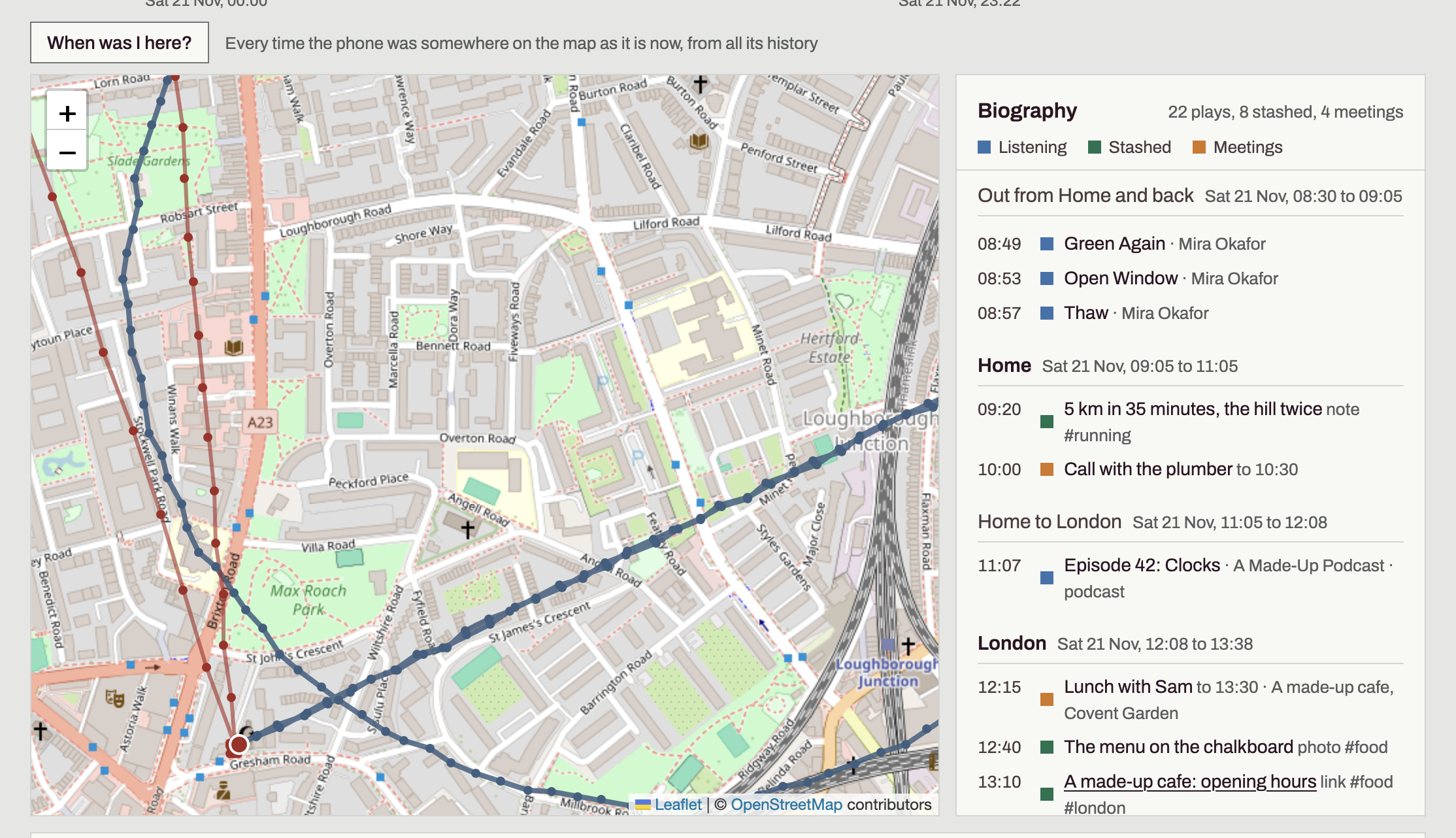 A screenshot of the “biography” service built on data my agent can read. Fake data.
Do not feed after midnight
Commercial agents will be just as context-hungry, but their incentives are not aligned with yours. Specifically, Meta want your data so they can make money out of it.
Louise Humpington came up with the brilliant metaphor of Muse as a mogwai: an appealing little mammal that will inevitably turn into a malevolent reptile.
That fluffy little smile is deceptive. It knows that the closer you cuddle it, the more reptilian it can afford to be. And because every fact is now potentially of value to the agent, it will invite us to surrender our data all the way down to the skin.
Once we would have depended on Google, Meta et al as the only ones who could offer services that need such depth of data. But AI has changed the balance of power.
Compared with 12 months ago, doing all this data-aggregating, agent-feeding work for yourself, with an AI coding tool, is feasible for the first time.
It’s become possible at the same moment the mogwai has turned up. So even though I need what it’s selling, I’m not letting it in.
What next
You could imagine smaller companies in this space, perhaps one of the AI coding tool shops like Lovable or Replit, offering a way to build these services on your own data and your own computer with no data mining in its business model.
I’m planning to write a separate post about how my system works, because the accretive layering of technologies that makes the DIY approach possible—NixOS, design systems, isolation patterns—might be worth copying for other applications.
And if anything I can share can help you run your own agent at home, so much the better. I’m wondering what the best way to “open source” a bunch of technical principles is. I’m eyeing the Phoenix architecture.
Comments
Reply on Bluesky to comment.